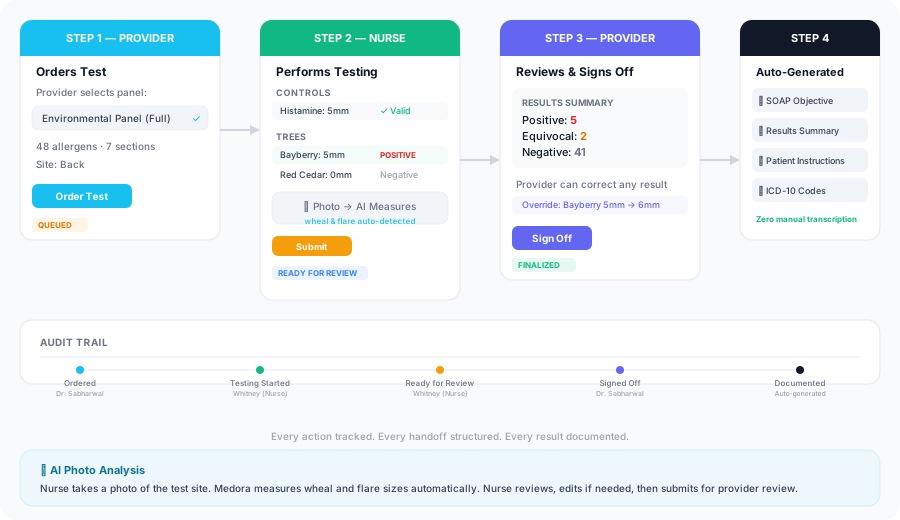
Skin prick (SPT), intradermal (IDT), and patch testing in one structured workflow. Provider orders. Nurse tests with photo capture and AI detection assist. Provider reviews. Documentation writes itself.
Used for real patient care at Allergy Affiliates. Every AI reading is reviewed by a nurse — nothing is finalized without a human.
Medora Vision — from $299/month for a solo allergist · free 30-day beta, no credit card · all tiers
Most allergy clinics still run skin testing on paper. It works — until it doesn't.
Handwritten wheal sizes vary by nurse. No enforced format. Abbreviations differ between staff. Results are hard to compare across visits.
Provider orders verbally. Nurse performs the test. Results communicated on paper or verbally. Provider may not see the raw data before documenting.
Test results get transcribed into the visit note by hand. Double-entry. Transcription errors. No structured audit trail.
Four steps. Two roles. One structured record — for SPT and IDT.
Role-based workflow with clinical guardrails, photo-assisted reading, and automatic documentation
The nurse photographs the test panel. Medora flags reactions per site as a second pair of eyes while the nurse measures and records each wheal and flare — the nurse's reading is always the system of record, and the AI never enters a measurement.
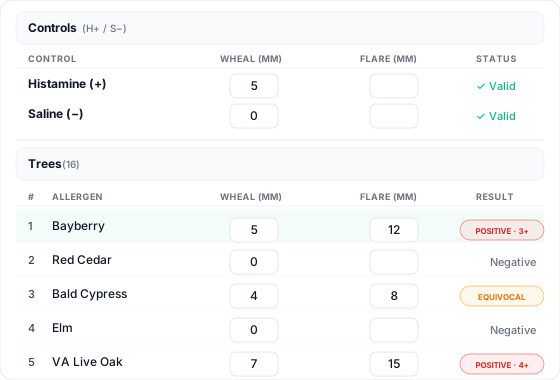
Skin prick panels organized by section — controls, trees, grasses, weeds, molds, foods. When SPT results come back, Medora suggests AAAAI-eligible intradermal candidates for the provider to consider. The provider decides.
Structured data entry that enforces consistency across nurses and visits. Histamine and saline control validation, required fields, and readings recorded following AAAAI conventions.
Test results flow directly into structured visit documentation. Per-allergen summary. Objective section populated. No manual transcription or double-entry — and the Scribe knows what the skin test measured, because they share the same patient context.
Contact dermatitis workups run on a multi-day clock — apply, then read on day 2, day 3–4, sometimes day 7. Medora keeps the whole series in one place, so no reading day gets lost between visits.
The provider orders the series; the nurse marks patches applied with an overview photo. Every step lands in the same patient record as SPT and IDT.
Day 2, day 3–4, and late day-7 readings each get their own photos and ICDRG grading (− to +++, IR). Structured capture — the nurse's reading is the record.
All reading days side by side, scores adjustable, then the provider signs and finalizes — the same review-first rule as every Medora workflow.
Developed, tested, and used daily at Allergy Affiliates — not a lab prototype
Every AI-flagged reaction is reviewed by the testing nurse, and the nurse's own reading is what counts. The human always decides.
Wheal and flare in millimeters, control validation, and IDT eligibility criteria aligned with AAAAI practice parameters.
HIPAA-compliant infrastructure with BAA. Encrypted at rest and in transit.
Straight answers about how Medora skin testing works
Yes. SPT and IDT run in the same structured workflow. After SPT review, Medora suggests AAAAI-eligible intradermal candidates — the provider always decides what to order.
No. Photo analysis flags reactions so nothing on the panel gets missed, but the nurse measures and records every value. Nothing is entered or finalized without a human.
Each site gets an explicit per-site reason when a measurement isn't available, and the nurse measures manually — the workflow never blocks on the AI.
Yes — daily, at Allergy Affiliates in Florida, by the nurses and providers who helped design it. Ask us for a live walkthrough of a real workflow.
Watch a real SPT and IDT session end-to-end, then ask us anything. Still on paper? Ask about our free skin-test documentation audit — send us your last 50 paper SPT records and we'll show you what structured capture would have caught.